Starting assumption
AI safety lessons for young adults
My original plan was to complement  , my career learning platform, with bite-sized AI safety lessons that would give young adults a route from Elm into the AI safety ecosystem.
BlueDot Impact × Fulcrum Challenge
Pathways into AI safety for experienced generalists

My original plan was to complement , my career learning platform, with bite-sized AI safety lessons that would give young adults a route from Elm into the AI safety ecosystem.
Help AI safety teams recognise relevant experience and bring it into senior roles.
I saw easing the bottleneck in generalist hiring as the most meaningful contribution I could make.
Estimated research fellows in 2026
~300 projected non-research fellows in 2026
5–10 estimated fieldbuilding hires per year from Pathfinder and Astra
In some non-research searches with hundreds of applications, the authors reported only 0–5 applicants meeting core requirements.
BlueDot estimated it could grow 3–5× in a year if it found the right hires.
In a separate case, one candidate went through eight hiring stages over eight months.
Learn the core AI risks and how organisations address them.
Match your existing skills to roles in AI safety.
Try a small project that resembles the work.
Target relevant jobs and fellowships.
Talk to advisers and people working in the field.
Build a portfolio of projects that show what you can do.
Share your work and use early feedback to improve it.
One application can lead to several rounds of screening, work samples and interviews.
The sequence and time commitment vary by role.
Hiring operations
Personal connections were reported as a main route into some roles.
Kairos advertises a $10,000 referral bonus.
Job readiness
Bundled responsibilities and unfamiliar job language made expectations harder to read.
Job readiness
Some hiring teams reported difficulty assessing external credentials and used familiarity with the field as a signal.
Job readiness · Hiring operations
Teams need to decide what a task should measure and how to score it. The research identified gaps in assessment design and evaluator expertise.
Feedback
Interviewees reported limited feedback after hiring decisions.
The criteria draw on the broader Pathwais evidence register, which logged 55 sources, including 4 study sources and 7 individual accounts.
Pathwais is a proposal to reduce friction in AI safety hiring by connecting candidates and hiring teams with the support they need at each stage. It could take the form of a toolkit, a targeted intervention, a consultancy, an independent body, or infrastructure that connects existing services. Pathwais would build on what already exists and work with organisations in the field to identify and address shared hiring challenges. The aim is to help organisations bring in the people they need sooner, so they can move faster on urgent work within the budgets they have.
If candidates can log their progress, revisit key learning, and find up-to-date guidance on courses, advisers, and applications, they’ll be more likely to retain what they learn and follow through on their next step.
If teams give candidates specific feedback after assessments and review recurring themes across hiring rounds, candidates will have clearer next steps and teams will see where to improve the process.
This feedback tool is one example of what the Pathwais toolkit could include. It shows how reviewers could record what a work sample revealed about transferable skills, share feedback with candidates, and improve the next hiring round.
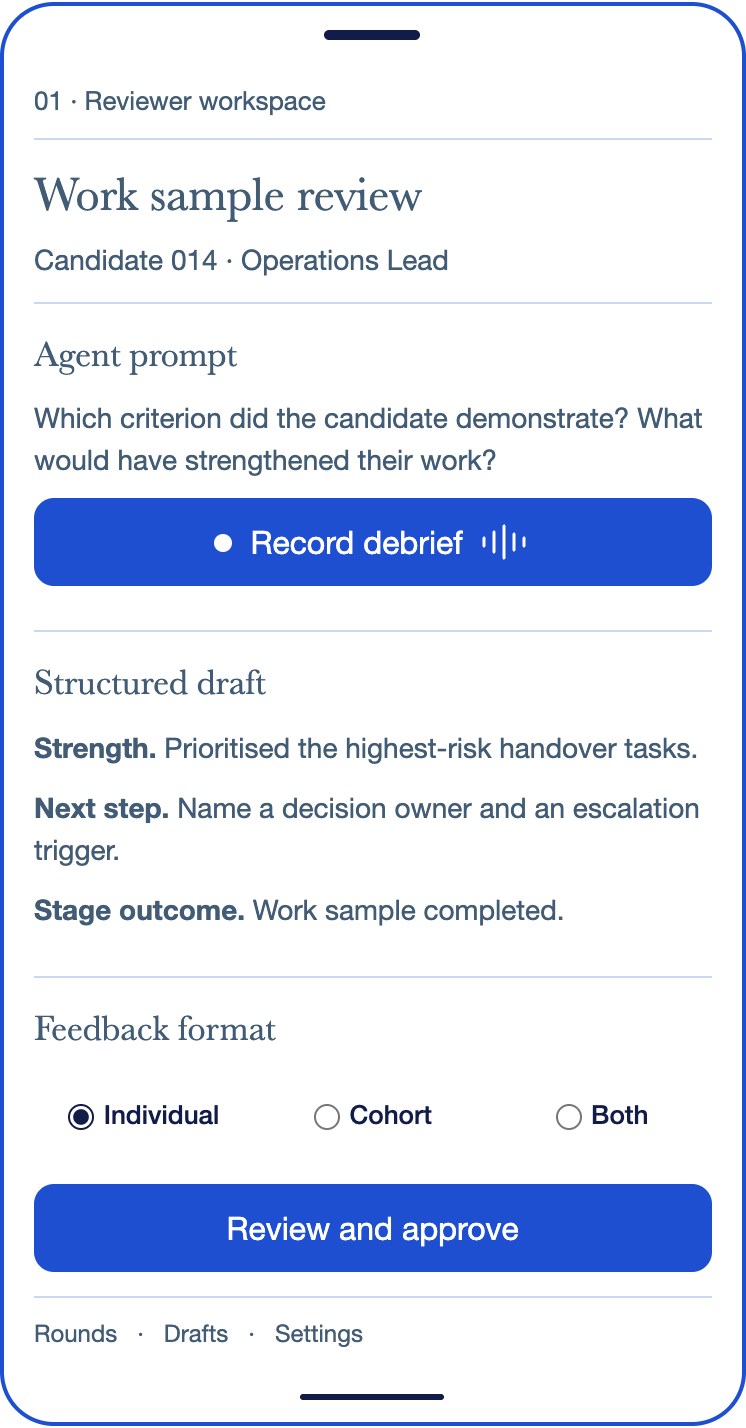
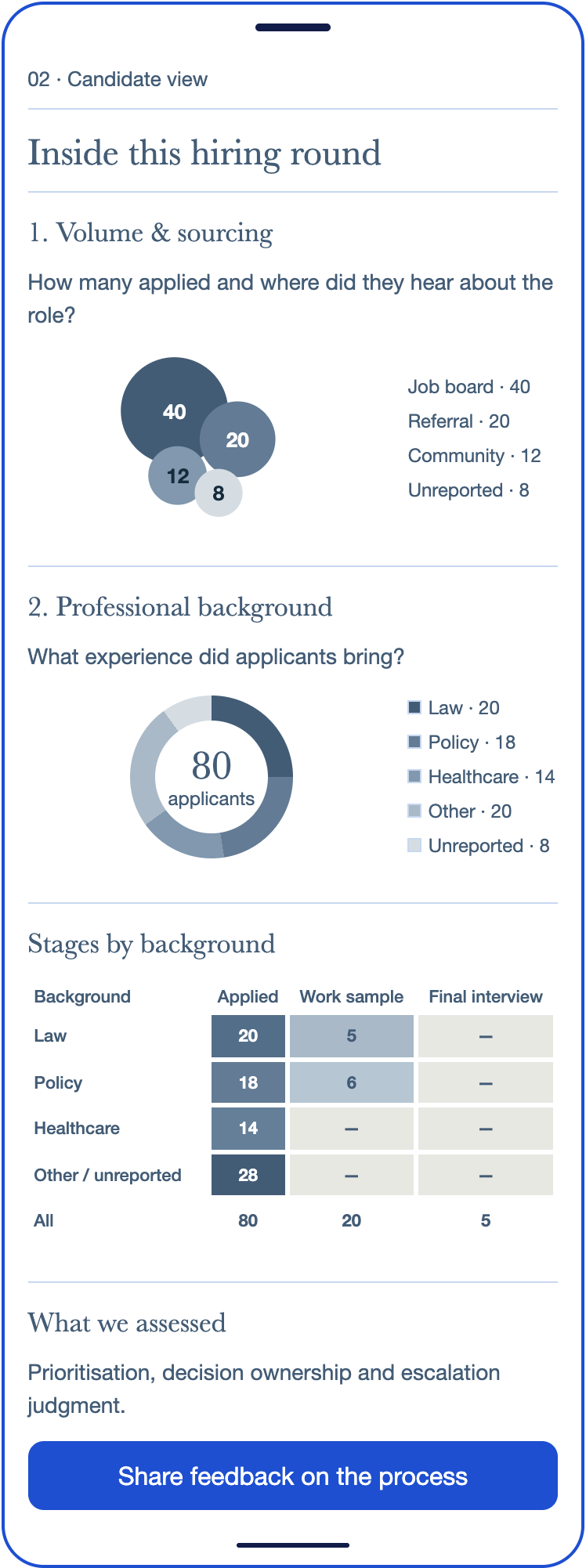
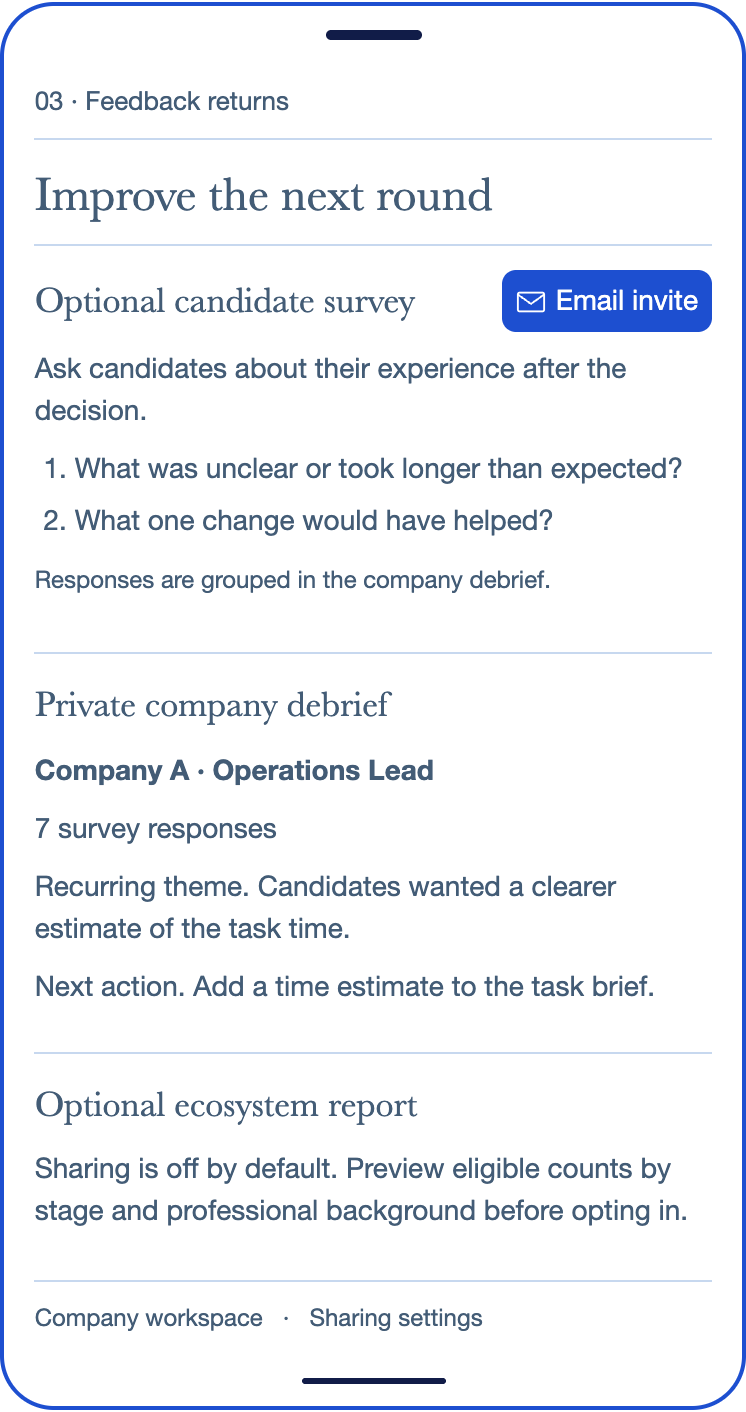
Prototype with fictional data. Open the mobile wireframe
Professionals we will speak with and survey
Kairos / Talent Commons, Leaf, Lateral, Coefficient Giving, Institute for Progress, MATS, Successif and High Impact Professionals.
Refine assumptions through targeted feedback
Use survey responses and targeted interviews to see which assumptions hold and refine what Pathwais should test first.
Experience the process as a candidate and, where possible, ask reviewers what evidence they needed. Use what I learn to decide which part of the process Pathwais could help improve.